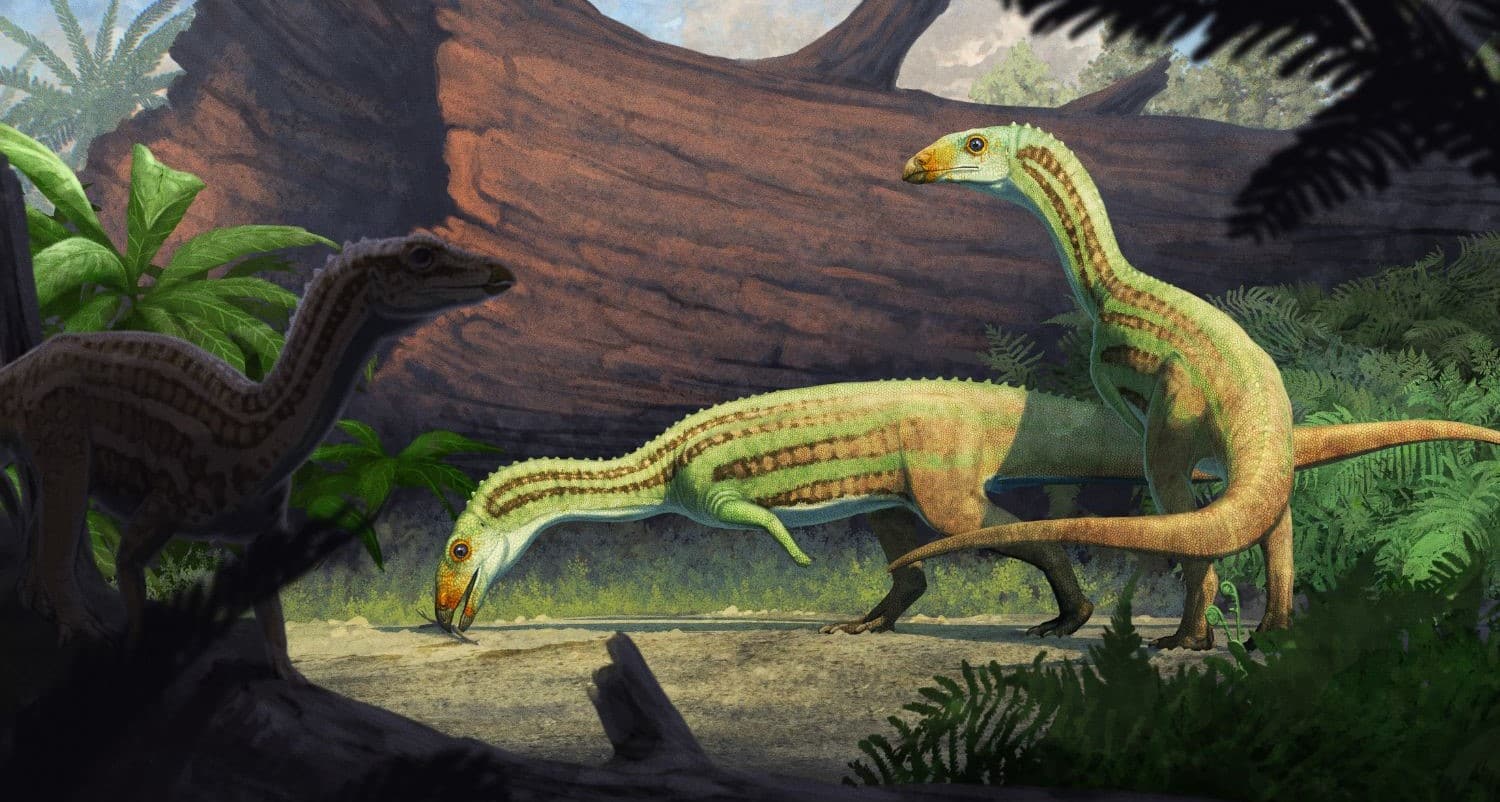
An ancient relative of crocodiles may have undergone an unusual transformation during growth: starting life walking on four legs and, as an adult, moving on two. The hypothesis arises in a new study published in the journal Journal of Vertebrate Paleontology.
The animal, designated Sonselasuchus cedrus, lived during the Late Triassic, about 225 to 201 million years ago, at a time when the first dinosaurs already inhabited the same ecosystems.
From quadrupedal to bipedal over the life
According to the researchers, the proportions of the limb bones suggest that these reptiles could undergo a change in locomotion as they grew.
In younger specimens, the forelimbs and hind limbs appear to have similar proportions, indicating a quadrupedal stance. However, fossils of more developed individuals show longer and more robust hind limbs, which could allow for a bipedal locomotion.
The study points to a process of differential growth: the hind legs would have grown more quickly than the forelimbs, altering the animal’s posture over the course of its life.
A “mimic” of the dinosaurs
Despite being a distant relative of crocodiles, Sonselasuchus presents characteristics frequently associated with some theropod dinosaurs, namely the Ornithomimidae — known as the “ostrich dinosaurs”.
Among these characteristics are:
-
a toothless beak
-
hollow bones
-
large eye sockets
-
possible bipedal locomotion
However, these similarities do not signify close kinship. The researchers argue that these are cases of convergent evolution, when distinct groups evolve similar solutions due to living in comparable environments and ecological niches.
A small inhabitant of the Triassic forests
Standing about 60 centimeters tall (approximately the size of a poodle), this reptile belonged to the group Shuvosauridae, a relatively uncommon assemblage of archosaurs related to the lineage that gave rise to crocodiles.
The fossils were found in the Petrified Forest National Park, in the United States, one of the most important Triassic paleontological sites. Since 2014, excavations at the site have recovered more than 3,000 fossils, including remains of fish, amphibians, dinosaurs and other reptiles.
In the case of Sonselasuchus, the researchers collected about 950 fossils, which allowed a more detailed reconstruction of the anatomy and lifestyle of this unusual animal.