Mine incidents have declined to less than a hundred per month due to a successful mine clearance and awareness campaigns addressing several million people throughout the country, according to the Organization for Mine Clearance and Afghan Rehabilitation (OMAR).
€œAs a result of successful mine awareness campaigns by OMAR and other agencies, mine victims have declined from several hundreds per month in the past years to around 60 incidents per month now, which is a big success this year,€ Alhaj Fazel Karim Fazel director of OMAR and a member of the Afghan Campaign to Ban Landmines (ACBL) told IRIN in the capital Kabul.
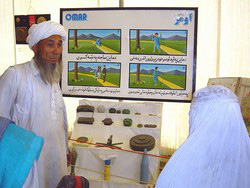
OMAR, which is running the biggest mine awareness programme in the world, claims to have educated over ten million Afghans on the risks of mines over the last ten years. Course take place wherever and whenever needed and focus on giving people the skills to identify and avoid the dozens of different types of land mines lying in Afghan soil.
Over the past 24 years of conflict, millions of land mines and unexploded ordnance (UXOs) have been scattered all over Afghanistan. The country is one of the most heavily mined and UXO strewn in the world. Unlike many other affected countries, almost 90 percent of the devices are lying on agricultural land, in irrigation systems, residential areas, roads and grazing grounds.
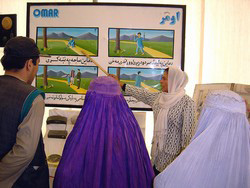
Women benefiting from mine awareness
Credit: IRIN
|
|
So far, 2.8 million explosive devices, including mines and UXOs, have been cleared from 320 million sq metres of land. But 815 million sq metres of land still have to be cleared to ensure the safe return of hundreds of thousands of internally displaced people (IDPs) and refugees. Refugees whose return is facilitated by the office of the United Nations High Commissioner for Refugees (UNHCR) repatriation programme have to go through mine awareness training before returning to their areas of origin.
Rahmatgul, a 45-year-old returnee, told IRIN he was shocked at seeing too many mine fields and land mine warnings the whole way along his route as he returned to Afghanistan via Tourkham border to the capital Kabul. €œI did not know mines would still be an impediment but almost every kilometre I saw either mine fields or mine awareness messages,€ said the father of six who came to the country after several years of exile in refugee camps in neighbouring Pakistan.
His home town of Shamali, just north of Kabul, was a battlefield for several years and he is not able to go back there until mines have been cleared. €œI have decided to settle in Kabul, because I was told Shamali is still heavily mined,€ he said.
OMAR believes Afghanistan will continue to have mine incidents as long as there is movement by refugees and IDPs in the country. €œAs far as we have large scale people movements in the country we will continue to have mine victims,€ Fazel said.
Meanwhile he noted illiteracy and poverty as the main challenges towards mine risk reduction in the post conflict country. €œ€Because most of the beneficiaries are illiterate and requires more illustrations than just text information. Meanwhile, people are poor and they send their children to collect metal fragments which is often land mines or UXOs,€ he maintained.


 Print view
![[Photo Credit: MAG/Sean Sutton]](images/hmaLOGO.jpg)
