Two years after the end of a brutal 27-year civil war, violence against women in Angola is on the rise. The conflict, in which over a million people were killed, had an adverse effect on the entire nation and has contributed to an increase in gender violence across all strata of society.
"The figures we have collected between 2001 and 2003 show that there's been an increase in violence against women," Solange Machado, a lawyer who specializes in helping female victims of violence at a women's centre in Luanda, told IRIN. The centre is run by the NGO Organizacao de Mulheres Angolana (Organisation of Angolan Women).
Machado said that in addition to the psychological effect of war, its material impact has played a significant role in the increase in gender violence. Today most of Angola's 13 million people live in dire poverty, despite the country's rich oil and diamond reserves.
Violence fed by material, psychological effects of war
"Many people don't have homes - you can have a whole family living in one room - that creates problems. Many people are unemployed and when they have jobs they tend to be badly paid. Everyone knows that when people don't have bread to eat they often turn to violence," Machado said.
"Every Angolan lost at least one family member during the conflict. Many people lived in parts of the country where they were confronted with the reality of war on a daily basis - gunshots, bombs and landmines," Eduarda Borja, a member of the Angolan NGO Rede Mulheres (Women's Network) told IRIN.
Angola's first elections in 1992 marked a turning point in the conflict. The results were disputed by the rebel movement UNITA and the war, which had been predominantly rural, spread to more populated urban centres in the provinces, Borja said.
"In addition to the physical destruction of buildings, people were unable to move around freely because of the fighting," she said. "The population, especially the young, became increasingly insensitive, yet no psychological work was ever done to help them get over the trauma of seeing friends and family killed with such ease."
"As a result of the war, many people resorted to violence to deal with their problems," a fact that was not limited simply to low-income households, Borja maintained.
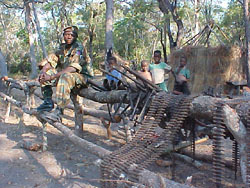
Government soldiers and guns at Calala demobilisation camp
Credit: IRIN
|
"Today, practically every Angolan family is home to some form of violence. In richer households, this violence can be more sophisticated, better hidden, but it still exists. In poorer families it is more brutal." she said.
Male insecurity
Angolan gender specialist Henda Ducados agreed that economic problems stemming from the conflict were at the root of the issue. "Because of the war, a lot of men are unemployed and unable to contribute to the household on a regular basis. It seems many feel undermined by the fact that women are bringing home the earnings. Their frustrations have often led to greater drug and alcohol consumption and violence against women," she said. "Men feel a sense of frustration from their economic condition, also the fact that many have come back from the war and haven't been reintegrated into society."
With around 4 million people displaced during the conflict, community and family structures simply broke down, Ducados said.
"In the past, when a couple got together, they needed the consent of both sides of the family and the community would usually follow the life of the couple and try to resolve any problems they had. However in peri-urban areas, people no longer care what the community is going to say about extra-marital affairs or the forming of secondary households," she said.
"Even if they're in an abusive or violent relationship, women's perception is that they would be worse off without a man around because they appear more vulnerable and insecure in the eyes of the community. Those who do leave their partners usually have support from their relatives," she added.
Laws against criminal violence needed
Meanwhile, much has still to be done to curb the growing phenomenon of gender-based violence. Machado maintains that Angola must work toward introducing legislation on violent crime. "At the moment there simply isn't enough in place in legal terms to force people to think twice before they turn to violence," she said. The government is sensitive to the problem, but there's still a long way to go before this kind of law is introduced - we first need to complete our studies and come up with a concrete proposal."
"Legal measures to punish those committing these acts of violence won't help to resolve the core of the problem," Borja argued. "Material conditions need to be improved and we need to see more psychological work and more programmes to teach people basic tolerance."


 Print view
![[Photo Credit: Jodi Bieber/MSF]](images/GBV-logoSpt04.jpg)
 ???
??? ???Our Bodies - Their Battle Ground: - the documentary