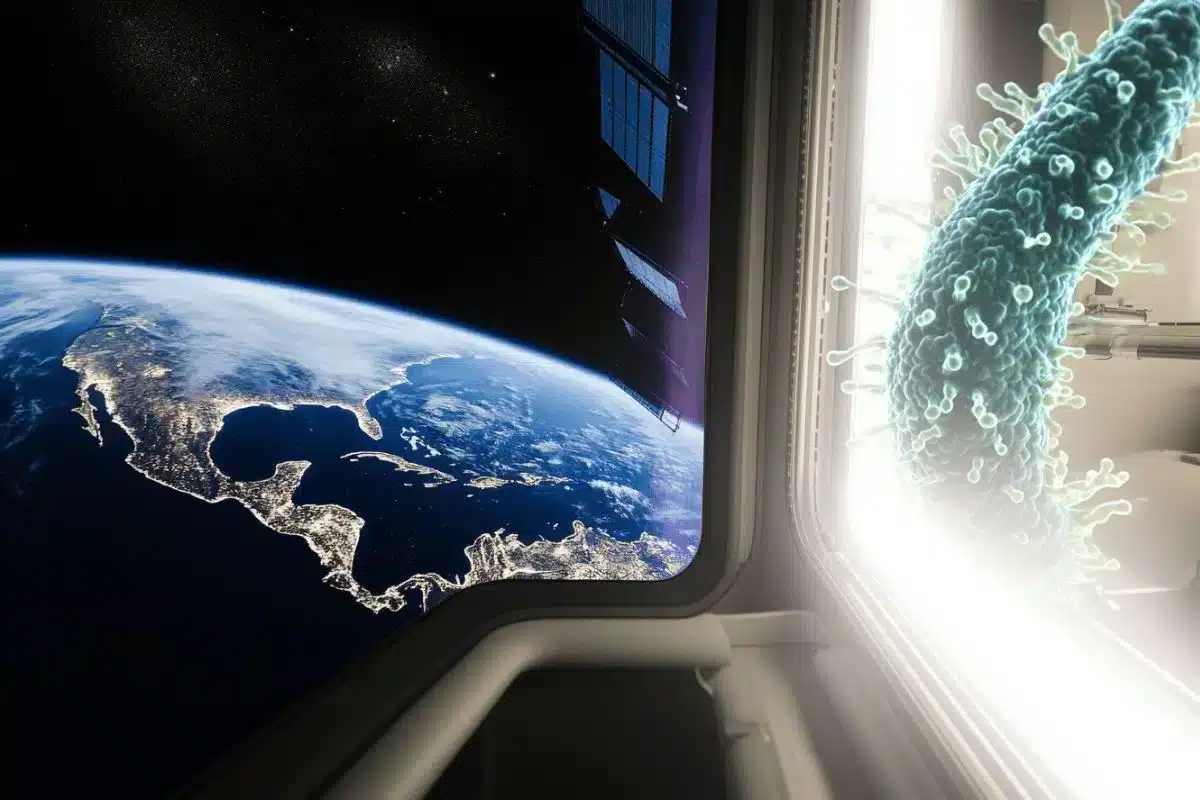
In orbit above Earth, Chinese astronauts have stumbled upon a discovery as startling as it is instructive: a new bacterium thriving inside the Tiangong space station. The microbe, provisionally named Niallia tiangongensis, crystallizes how quickly life can adapt when subjected to the stresses of space. While the station remains safe and operational, the finding forces mission planners to rethink how astronauts live with, monitor, and manage microscopic communities in sealed habitats.
A microbe emerges in orbit
The organism surfaced during routine sampling in May 2023, when the Shenzhou-15 crew collected swabs across the station’s habitation module. Genetic analysis under the CHAMP program tied the new bacterium to Niallia circulans, a hardy soil species once grouped within Bacillus. Yet the space-adapted strain is anything but a standard cousin. Its genome and behavior diverge in ways that reflect a swift evolutionary response to microgravity and constant sanitation.
Most striking, the bacterium evolved an unusually efficient metabolism for degrading gelatin, extracting nitrogen and carbon from a substrate common in lab reagents and certain station materials. At the same time, it appears to have shed some versatility, relying on a narrow set of fuels rather than the broader range used by its terrestrial relatives. Researchers also see evidence of enhanced spore resilience, robust biofilm formation, and traits that help it persist through cleaning cycles.
Why space reshapes life
Orbital habitats impose a series of stressors that act as a sieve on microbial diversity and function. In Tiangong’s closed loop, a handful of forces dominate selection:
- Persistent microgravity, which alters cellular architecture and gene expression
- Elevated ionizing radiation, which damages DNA and accelerates mutation
- Confined air and water loops, which reduce ecological diversity and competition
- Rigorous antimicrobial protocols, which favor organisms that endure or evade cleaning
- Isolation from Earth’s microbial reservoir, which limits re-seeding and balance
Together, these conditions push microbes toward specialization. Studies aboard Tiangong reveal a microbiome with a strong human signature—skin and airway associates—yet with functions that diverge from their Earth-bound counterparts. The result is a community optimized for life in microgravity, where film-forming behaviors and stress responses become key survival strategies.
Risks for crews and systems
Researchers stress that it remains unclear whether Niallia tiangongensis poses direct health risks. Still, its kinship to bacteria that can turn opportunistic under stress warrants caution, especially because astronauts often experience suppressed immunity on long missions. Even non-pathogenic microbes can become problematic when the host is vulnerable or the environment is uniquely constraining.
Operational risks may be more immediate and measurable. Biofilms can coat sensors, valves, and filters, reducing performance and accelerating corrosion. Microbes can influence air and water quality, complicate maintenance schedules, and introduce uncertainty in experiments that assume sterile baselines. On missions far from Earth, where resupply and rapid repair are limited, such seemingly minor degradations can cascade into mission-threatening failures.
From control to stewardship
The discovery underscores a broader shift in how space agencies think about cleanliness and control. Sterility is a moving target in a habitat that people inhabit, shed microbes into, and clean on fixed cycles. A more resilient framework treats the station’s microbiome as an ecosystem to be continuously measured, guided, and strategically influenced.
Next-generation safeguards could combine real-time DNA sequencing with environmental sensors to map microbial flows and hotspots. Surfaces might integrate smart coatings that discourage adhesion without breeding resistance. Cleaning could become more targeted, using data to neutralize biofilms while preserving benign competitors that keep opportunists in check. Even materials selection—seals, polymers, and panel finishes—can be designed to frustrate microbial colonization.
“Space is not sterile; it is selective,” notes one mission microbiologist. “What survives in orbit does so because the environment demands it—and that makes these organisms both a warning and a window into evolution.”
What this means for exploration
As crews prepare for longer sorties—lunar bases, deep-space transits, and eventual Mars stays—the microbiome becomes a life-support variable, not a background nuisance. Understanding which organisms help recycle waste, stabilize air and water loops, or produce useful compounds will be as important as suppressing species that threaten health or hardware. In this light, Niallia tiangongensis is less a villain and more a signal: a reminder that every sealed habitat breeds its own micro-ecology, one that responds to human routines, materials, and mission constraints.
The Tiangong finding also aligns with wider patterns in extreme biology, where organisms endure radiation, dehydration, and isolation in places once thought inhospitable. Each such discovery nudges science toward a pragmatic view of cleanliness in space—less about enforcing perfection, and more about dynamic risk management guided by continuous data.
For astronauts, the path forward is equal parts vigilance and design. Better biosurveillance, smarter materials, and ecosystem-aware protocols can turn a potential threat into a teacher. The lesson is clear: in the quiet, engineered world of a space station, microscopic life will innovate. Our task is to learn quickly, respond precisely, and make the space microbiome an ally rather than an adversary.