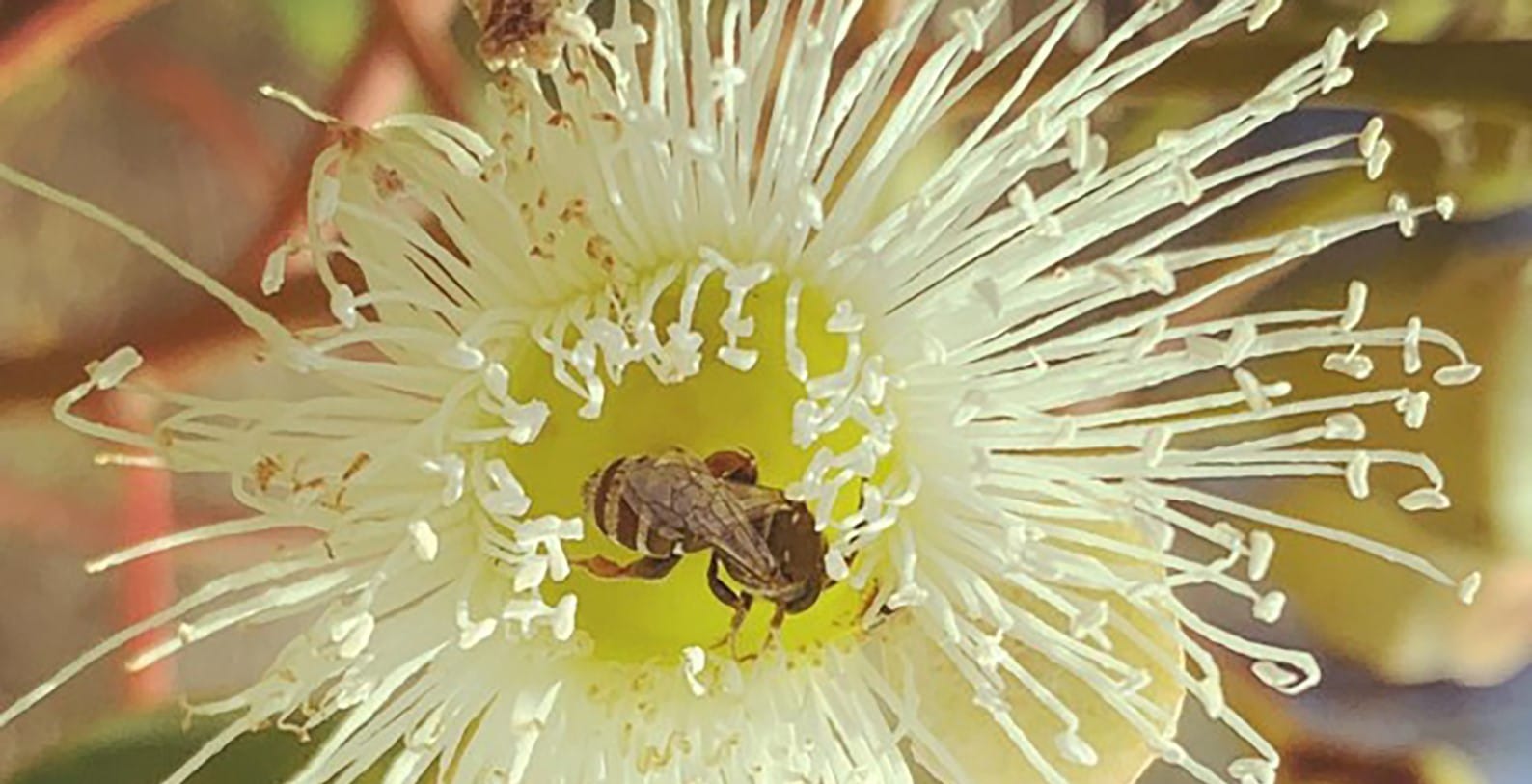
A new investigation conducted by Curtin University revealed that the Marri trees are fundamental for the survival of more than 80 species of native bees in the southwest region of Western Australia, which is one of the world’s biologically richest but most threatened biodiversity hotspots.
The lead author, Kit Prendergast, a Curtin School of Molecular and Life Sciences postdoctoral researcher, said the study identified the Marri (Corymbia calophylla), which is native to the Southwest and was named a Near Threatened species in 2019, as a crucial food provider for native bees and a guardian of the region’s ecosystem.
“The findings that these trees support at least 81 different species of foraging bees in the Southwest highlight their extraordinary role in the survival of native bee populations, particularly late in summer, when most other plants have ceased flowering,” says Prendergast.
“As native bees in WA’s Southwest are abundant and incredibly diverse, many rely heavily on native plants like the Marri for food,” he adds.
“The Marri trees provide vital nectar and pollen, especially at a time when few other plants are in flower. For many bee species, the Marri is often the only food source available at this time of year,” he reveals further.
“Moreover, this tree not only provides food sources for native bees, but also nesting resources, with species observed nesting in small holes and among the roots, and its copious iconic red sap is used by Megachilidae bees to seal their nests,” he continues.
Prendergast states that the research provides new evidence supporting the idea that certain species, such as the Marri tree, serve as “keystone species” or “indicator species,” playing an especially crucial role in maintaining biodiversity.
“The Marri is a vital resource for native bees, acting as a lifeline during critical periods when other plants dry up,” says Prendergast.
“The results point to an urgent need to protect the Marri trees from threats such as logging, mining, wildfires, diseases, agriculture and urban and industrial development, because without this tree, many species of native bees would struggle to survive,” he adds.
The study also revealed that Marri trees are often the primary, or sole, plant species visited by these bees throughout the year, making them indispensable in the local ecosystem, underscoring the importance of conserving this species not only for the bees but for the health of the landscape in general.
The investigation was funded by the Forrest Research Foundation, by Zanthorrea Nursery and by the Department of Biodiversity, Conservation and Attractions.
The full study, titled “Corymbia calophylla (Marri): A Major Resource for Native Bees in the Southwest Western Australian Biodiversity Hotspot” will be published in the journal Pacific Conservation Biology (doi.org/10.1071/PC24054) and once published will be online here.