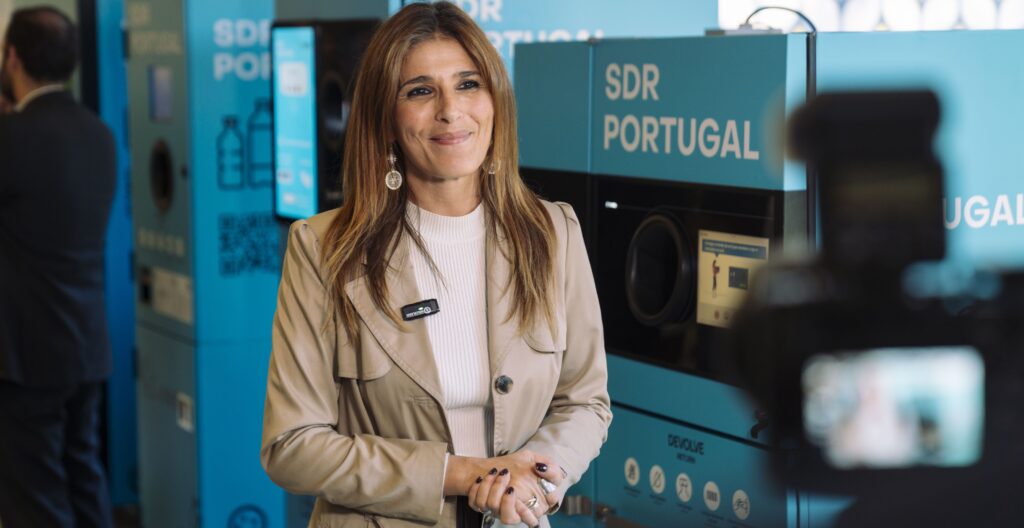
For SDR Portugal, April 10, 2026 marks the turning point of a process that began with the license award in 2024 and that required large-scale technological, logistical and operational advances. The installation of the return machines, the creation of counting and sorting centers, and the development of the national IT system are already in an advanced stage, ensuring that the launch proceeds with reliability and convenience. In an interview with Green Savers, Lia Oliveira, Marketing and Communications Director of SDR Portugal, explains that the system’s impact will be evident both in reducing waste and in increasing recycling rates, as well as in the cultural shift involving producers, retailers and consumers in a shared responsibility model.
The person in charge acknowledges that installing more than two thousand machines across the country is an unprecedented challenge, but emphasizes that the retail sector has been a central partner in building a robust and operational network. Technology will play a decisive role, from the individual traceability of each packaging item to digital auditing and system transparency.
With an investment exceeding 150 million euros and stringent European targets, SDR Portugal believes this is a decisive step in the country’s transition to a circular economy. The final message is clear: the success of the system will depend on everyone’s participation, because every bottle and every can returned matters.
The Government recently announced that the Deposit and Return System (SDR) will come into force on April 10, 2026. What does this date mean for SDR Portugal, and at what stage is the preparation process?
The date of April 10, 2026 represents a historic milestone for SDR Portugal and for the country. It is the culmination of a preparation process that has been underway since the license was awarded in 2024 and involves intensive work on several fronts: technological, logistical, institutional, and communications. The Deposit and Return System (SDR) for single-use beverage packaging made of plastic, aluminum and steel up to three liters has as its main objective to encourage recycling, promote material valorization, and involve producers and consumers in a model of a circular economy. A change that is transforming the way we relate to single-use beverage packaging.
The Deposit and Return System (SDR) for single-use beverage packaging made of plastic, aluminum and steel up to three liters has as its main objective to encourage recycling, promote material valorization, and involve producers and consumers in a model of a circular economy. A change that is transforming the way we relate to single-use beverage packaging
Neste momento, a SDR Portugal encontra-se em fase avançada de implementação, com a instalação progressiva das máquinas de devolução automática (RVMs), o desenvolvimento do sistema informático nacional que permitirá rastrear todas as embalagens e os mecanismos de reembolso, bem como a criação dos centros de contagem e triagem e a definição da logística de recolha. Esta fase é determinante para garantir que, no arranque, o sistema funciona com a fiabilidade e conveniência necessárias para o consumidor. Estamos ansiosos por este 10 de abril, mas bem preparados.
The SDR represents a profound change in the way Portuguese people handle their beverage packaging. What environmental and social impact do you expect to achieve in the first years after launch?
The impact will be transformative – not only in the numbers, but also in the way we view packaging.
SDR Portugal will contribute to reducing littering by up to 40% and significantly increasing the collection and recycling rates of packaging, reaching 90% of the collection of this type of packaging by 2029. This high-quality collection will enable the generation of recycled material suitable for contact with food, effectively closing the packaging loop.
If, environmentally, the numbers are already impressive, the social impact will be equally profound
If, environmentally, the numbers are already impressive, the social impact will be equally profound. SDR Portugal represents a cultural shift that unites and involves citizens, producers and retailers in a joint effort to valorize resources and reduce waste. We are privileged to be at the forefront of this transformation that will mark future generations.
The operation involves the installation of more than two thousand collection machines across the country. What challenges have you encountered in implementing a network of this size?
The scale of the project is unprecedented in Portugal and in Europe and requires total coordination between public entities, operators and retailers.
The challenges include ensuring balanced territorial coverage, with machines installed across the country, including the autonomous regions of Madeira and the Azores, and ensuring the technical and logistical integration between the 2,500 machines (RVMs), the central IT system, and the counting and sorting centers. Another challenge is adapting retail spaces, which require suitable conditions to accommodate the machines and the packaging flows. At the same time, we are ensuring staff training and the implementation of audit and anti-fraud mechanisms that guarantee the system’s integrity. It has been a joint effort to ensure nothing is left to chance and that there is trust among all stakeholders.
The challenges include ensuring balanced territorial coverage, with machines installed across the country, including the autonomous regions of Madeira and the Azores, and ensuring the technical and logistical integration between the 2,500 machines (RVMs), the central IT system, and the counting and sorting centers
Consumer involvement will be decisive for the success of the system. What communication and awareness strategies are being prepared to ensure broad participation?
That, indeed, will be the greatest challenge – truly engaging the consumer.
We are preparing a national communication campaign focused on education, convenience and the system’s transparency. We want to simplify SDR as much as possible to ease consumer adaptation. The system’s success will depend on this: that the public understands that it is convenient and advantageous.
Before the launch, on April 10, 2026, a set of awareness-raising actions and practical demonstrations will be promoted, so that everyone can become familiar with how the system works and the reimbursement process
Before the launch, on April 10, 2026, a set of awareness-raising actions and practical demonstrations will be promoted, so that everyone can become familiar with how the system works and the reimbursement process.
The retail sector also plays a central role in this process. How has collaboration with distributors been, and how will stores integrate the SDR into their daily operations?
Retail is a pillar of the system, both in operational terms and in consumer awareness. SDR Portugal is made up of a group of companies that bring together more than 90% of the beverage and retail sector operating in the country, which guarantees solid and coordinated collaboration.
A SDR Portugal is composed of a set of companies that bring together more than 90% of the beverage and retail sector operating in the country, which ensures solid and coordinated collaboration
Stores will integrate the SDR through dedicated return zones, properly signposted, with user-friendly automatic machines. There will be training for store teams and the integration of collection flows into the daily operation, ensuring a convenient and smooth experience for the consumer.
Seeing the entire retail sector and the packagers working together in support of this system only gives us more certainty of how necessary and transformative it is for Portugal.
The system will cover beverage bottles and cans, such as water, soft drinks or beers, but excludes dairy products and wine. Why were these left out and could this decision be revised in the future?
The exclusion of dairy products and wine in the initial phase of the Deposit and Return System (SDR) is due to technical and sanitary reasons. These products may compromise the quality of the collected materials and contaminate the recycling process.
The exclusion of dairy products and wine in the initial phase of the Deposit and Return System (SDR) is due to technical and sanitary reasons. These products may compromise the quality of the collected materials and contaminate the recycling process.
The focus of the SDR is technical and strategic: to start with materials with the greatest potential environmental impact and the lowest collection rate – PET and metal – ensuring efficiency, traceability and compliance with European targets. We are learning from international experience and conducting studies in Portugal to guide us in the best possible way.
Portugal has demanding European targets: collect 90% of packaging by 2029 and ensure 65% recycled material in plastic bottles by 2040. What plans and intermediate targets has SDR defined to reach these objectives?
Demanding, but achievable. International experience, in the SDRs of other European countries, shows that on average collection rates reach 90% after a few years of system implementation. This fact is a guarantee that our path is attainable and that we will reach 90% selective collection in 2029 in an evolutionary manner, with ongoing investment in technology, awareness and logistical efficiency. Parallely, the system will contribute to plastics bottles incorporating 65% recycled material by 2040, closing the loop of the circular economy.
Our path is achievable and we will manage to reach 90% selective collection in 2029 in an evolutionary manner, with ongoing investment in technology, awareness, and logistical efficiency. At the same time, the system will contribute to plastics bottles incorporating 65% recycled material by 2040, closing the loop of the circular economy.
2026 will be a decisive year to achieve excellent results.
Technology will be one of the pillars of the SDR. What digital and logistical solutions are being developed to ensure the system’s efficiency, control and transparency?
Technology is, indeed, the heart of the Deposit and Return System. SDR Portugal is implementing a national IT system that ensures real-time data collection and integration, from the provisioning of packaging to its return and recycling.
Each bottle and can will be identified by a unique code (EAN-SDR) and automatically recognized by the return machines (RVMs), which allows total traceability, digital auditing, and anti-fraud control.
From a logistical standpoint, technologically equipped sorting and counting centers are being developed, responsible for ensuring the quality of the collected material and optimizing transportation routes. The system will also be accompanied by continuous monitoring mechanisms, under the supervision of APA, DGAE and ERSAR, ensuring transparency, safety and public trust.
This is an intelligent infrastructure, capable of generating real-time information and ensuring that each packaging has a definite destination, contributing to a fully digitalized and monitored circular economy model
In short, it is an intelligent infrastructure, capable of generating real-time information and ensuring that each packaging has a definite destination, contributing to a fully digitalized and monitored circular economy model.
Beyond the environmental aspect, SDR can also generate economic and social value. What impact do you expect it to have on the circular economy and the creation of new opportunities in the recycling and waste management sector?
SDR Portugal represents a new circular economy in action, with environmental, economic and social impact. Its implementation involves a national investment exceeding 150 million euros, fully financed by the subscribing companies.
More than a system, it is a driver of economic transformation. SDR Portugal will generate new value chains in the recycling industry and in technological innovation, boosting the development of high-quality recyclable materials and encouraging investment in green technologies. The result will be a greener and more sustainable country.
It will contribute to reducing up to 40% of littering and significantly reducing marine litter, reinforcing Portugal’s environmental credibility and the fulfillment of European commitments.
Moreover, it will contribute to reducing up to 40% of littering and significantly reducing marine litter, reinforcing Portugal’s environmental credibility and the fulfillment of European commitments.
What message would you like to leave to Portuguese consumers about the role each one can play in this new consumption model?
First of all, that every citizen in Portugal understands that their participation in this System is fundamental.
Each citizen will have a crucial role in this change. The Deposit and Return System will only be successful if everyone participates, because every returned packaging counts.
The message is simple: every bottle and every can has value. By returning them, we are giving them a new life, contributing to a cleaner environment and a more sustainable country
The message is simple: every bottle and every can has value. By returning them, we are giving them a new life, contributing to a cleaner environment and a more sustainable country.
This is a system designed for everyone and conceived to be convenient, transparent and accessible. With a quick gesture, at the nearest supermarket, each person can be part of a national transformation. With this step, Portugal takes a significant leap in the transition to the circular economy. And success will depend on the participation and commitment of each one of us.