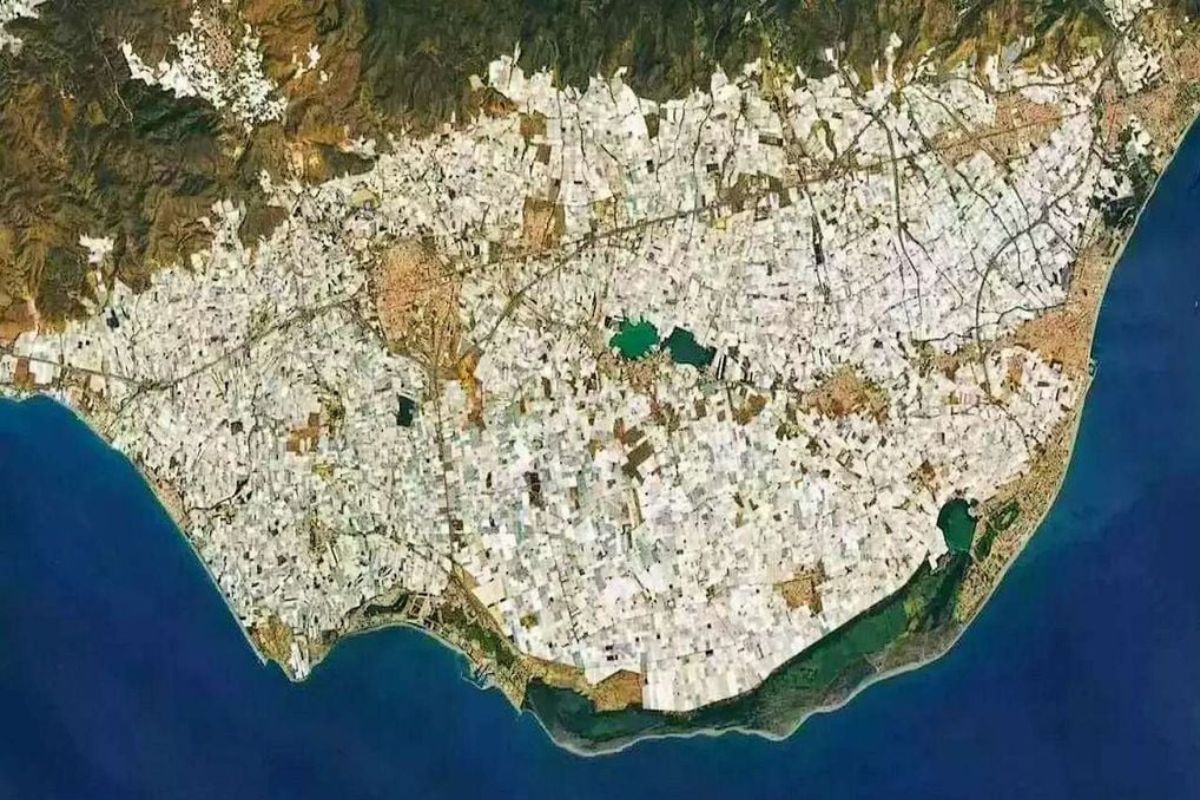
Europe hides an unlikely landmark that outshines many famed monuments when viewed from space. Along Spain’s Mediterranean coast, a vast mosaic of greenhouses turns Almería into a gleaming expanse that astronauts easily spot. This “sea of plastic” covers tens of thousands of hectares, forming a dazzling white patch that makes modern agriculture unusually visible from orbit.
The unexpected giant seen from orbit
From high above, sunlight reflects off millions of panels, creating a signature brighter than surrounding land and sea. The result is a human-made landscape so distinct that it serves as a reference point for those looking down from the International Space Station.
- About 40,000 hectares of greenhouses, roughly 100,000 acres
- Highly reflective white plastic, boosting orbital visibility
- Dense clustering near Almería’s coast, enhancing the bright contrast
- Regularly captured in NASA and ESA imagery, confirming the bold footprint
“From orbit, Almería appears as a brilliant white veil along Spain’s southern shore, impossible to miss against the deep blue of the Mediterranean.”
The science behind the sight is simple yet profound. White roofs increase albedo, bouncing sunlight back into space and slightly cooling the local microclimate. In a region defined by heat and aridity, that cooling effect is both a quirk of physics and a practical benefit.
How a desert became Europe’s pantry
Just decades ago, Almería was an arid frontier with meager rainfall and relentless winds. Traditional crops struggled in sandy soils, and the economy lagged behind Spain’s heartlands. Everything changed when farmers adapted low-cost greenhouse designs to local conditions, harnessing drip irrigation, windbreaks, and sheltered microclimates to push yields ever higher.
What began as a pragmatic solution turned into a continental powerhouse. Today, Almería supplies a remarkable share of Europe’s off-season vegetables, from tomatoes and peppers to cucumbers and melons. Behind the plastic, sophisticated systems automate climate control, regulate moisture, and reduce pests through biological controls rather than heavy chemical use. The overarching goal is predictable output with leaner inputs of water and energy.
This productivity also mirrors shifting consumer expectations. Year-round demand for fresh produce pushed supply chains to stabilize harvests against weather, seasonality, and volatility in global markets. Almería, in this sense, is a living laboratory for agricultural resilience.
Promise and pitfalls of plastic agriculture
The “sea of plastic” is both innovation and challenge, inviting praise and scrutiny. On the plus side, controlled environments save water, cut spoilage, and tame pests without blanket pesticide use. On the downside, plastic waste, groundwater stress, and soil fatigue require constant management and reform.
The industry has moved toward smarter, cleaner practices. You’ll find recycling programs for plastics, expanded drip irrigation and recapture systems, and widespread adoption of integrated pest management. Many farms pursue environmental certifications, indicating a measurable shift toward better standards.
Yet the social dimension complicates the picture. A large migrant workforce underpins the region’s success, raising concerns about housing, wages, and fair protections. True sustainability must account for both ecological health and human dignity.
Emerging solutions point to a more sustainable future:
- Solar-powered desalination to reduce aquifer pressure
- Biodegradable films that limit long-term waste
- Renewable energy integrated into climate-control systems
- Regenerative techniques to rebuild soils and biodiversity corridors
Lessons for a warming world
As climates trend hotter and drier, the Almería model offers insights for food systems under stress. Reflective roofing and targeted irrigation help conserve water while stabilizing yields; modular structures adapt to volatile weather, and coordinated logistics ensure rapid farm-to-market delivery. In water-scarce regions, such tools can bridge gaps between scarcity and supply, provided governance remains robust and safeguards are in place.
The view from space is more than a visual curiosity; it is a stark symbol of how thoroughly humans can reshape a landscape. That bold white swath tells a story of ingenuity, trade, and the costs of convenience, pressing us to weigh abundance against impact. If the next chapter is written with cleaner materials, smarter energy, and fairer labor, Almería could evolve from a sea of plastic into a blueprint for resilient agriculture.
In the end, the most striking thing isn’t just what astronauts see, but what the rest of us must learn: feeding a continent in a changing climate will demand innovation, vigilance, and a commitment to balance.