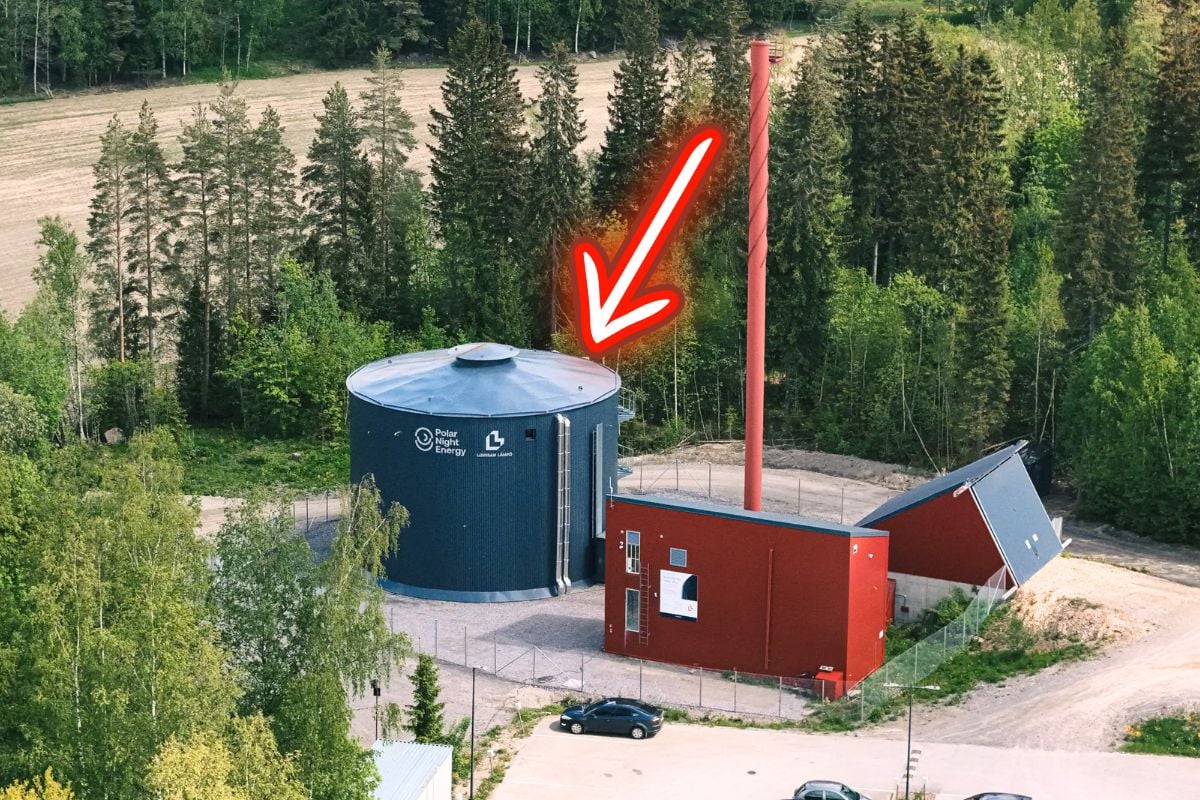
In a quiet town in western Finland, engineers have achieved something truly revolutionary — a massive sand battery capable of storing clean energy on an unprecedented scale.
Weighing over 2,000 tons and boasting a 100-megawatt capacity, this groundbreaking installation has officially become the largest sand-based energy storage system in the world.
Developed by Finnish startup Polar Night Energy, the project represents a milestone in renewable energy storage, using something as simple and abundant as sand to tackle one of the sector’s toughest challenges: how to store green energy efficiently and affordably.
A Simple Idea With Monumental Impact
At first glance, it sounds almost too simple.
The system works by heating tons of dry sand to temperatures of up to 600°C (1,112°F) using excess electricity from solar, wind, or other renewable sources.
That thermal energy can then be stored for months and later released to provide district heating or electricity when demand spikes.
What makes it remarkable is its low cost, scalability, and durability.
Unlike lithium-ion batteries, sand doesn’t degrade over time, doesn’t rely on rare minerals, and poses no fire or pollution risk.
“We wanted to prove that energy storage doesn’t need to be complicated or toxic.
Sand is everywhere, cheap, and surprisingly powerful when you know how to use it.”
— Markku Ylönen, co-founder of Polar Night Energy
Breaking Records — and Expectations
The new 100 MW installation, located near the coastal city of Kankaanpää, dwarfs the company’s first prototype — a 4 MW pilot built in 2022 that caught the attention of scientists worldwide.
Now, this full-scale system is capable of storing enough heat to supply 20,000 households through the frigid Finnish winter.
Its storage capacity reaches an astonishing 8 gigawatt-hours (GWh), allowing it to hold energy for up to five months without significant losses.
This makes it one of the longest-duration thermal storage systems on Earth — and a potential blueprint for cold-weather nations seeking sustainable heating solutions.
How It Works: The Science Behind the Sand
The sand battery’s operation is deceptively simple yet scientifically ingenious.
Electricity from the grid — ideally from wind turbines or solar panels — powers resistive heating elements inside a large insulated silo filled with sand.
As the sand heats up, it acts as a giant thermal sponge, storing energy in the form of heat.
When energy is needed, air is circulated through the hot sand, and the generated hot air is used to heat water for district heating systems or converted back into electricity via turbines.
Key technical specs of Finland’s record-breaking sand battery:
- Storage material: 2,000 tons of dry, coarse sand
- Thermal storage capacity: 8 GWh
- Output power: 100 MW
- Operating temperature: up to 600°C
- Estimated lifespan: over 30 years
- Energy loss: less than 10% over several months
The system’s efficiency for heating applications exceeds 95%, making it far more practical than most chemical or hydrogen-based storage solutions for grid balancing.
Why Finland Is Leading the Charge
Finland’s long, dark winters make it a perfect testing ground for renewable innovation.
The country faces extreme energy challenges — limited sunlight, high heating demand, and growing pressure to phase out fossil fuels.
By turning sand into an energy vault, Polar Night Energy has offered a solution that’s not just green, but adapted to northern realities.
It allows local utilities to capture and reuse surplus summer solar or wind power during the freezing months of January and February, when energy use peaks.
“This is the missing link in renewable energy.
You can’t rely on the sun or wind alone — but you can store their power until you need it most.”
— Dr. Sini Lehtinen, energy systems researcher at Tampere University
A Global Model for Clean Energy Storage
Experts believe Finland’s innovation could reshape the global energy landscape.
Countries like Canada, Norway, and Germany have already expressed interest in adapting the technology for their own district heating systems.
And because sand is cheap and easy to source, the technology can scale rapidly without the environmental footprint of battery mining.
It also offers a way to stabilize renewable grids by absorbing excess production — a major challenge as solar and wind expand worldwide.
By converting electricity into storable heat, sand batteries bridge the gap between intermittent supply and constant demand.
Environmental benefits include:
- Zero toxic waste or heavy-metal pollution
- No dependence on lithium or rare earths
- Minimal maintenance and land use
- Fully recyclable materials
The Future Is Made of Sand
The success of Finland’s sand battery sends a clear message:
the future of energy storage doesn’t just belong to complex chemistry or futuristic materials — it may lie in something as humble as sand.
As Europe races toward carbon neutrality, solutions like this could transform entire energy systems, making renewables not only cleaner but more reliable than ever before.
For now, in a quiet corner of Finland, 2,000 tons of sand are glowing silently, holding the warmth of the summer sun — ready to power homes and hearts through the coldest nights.