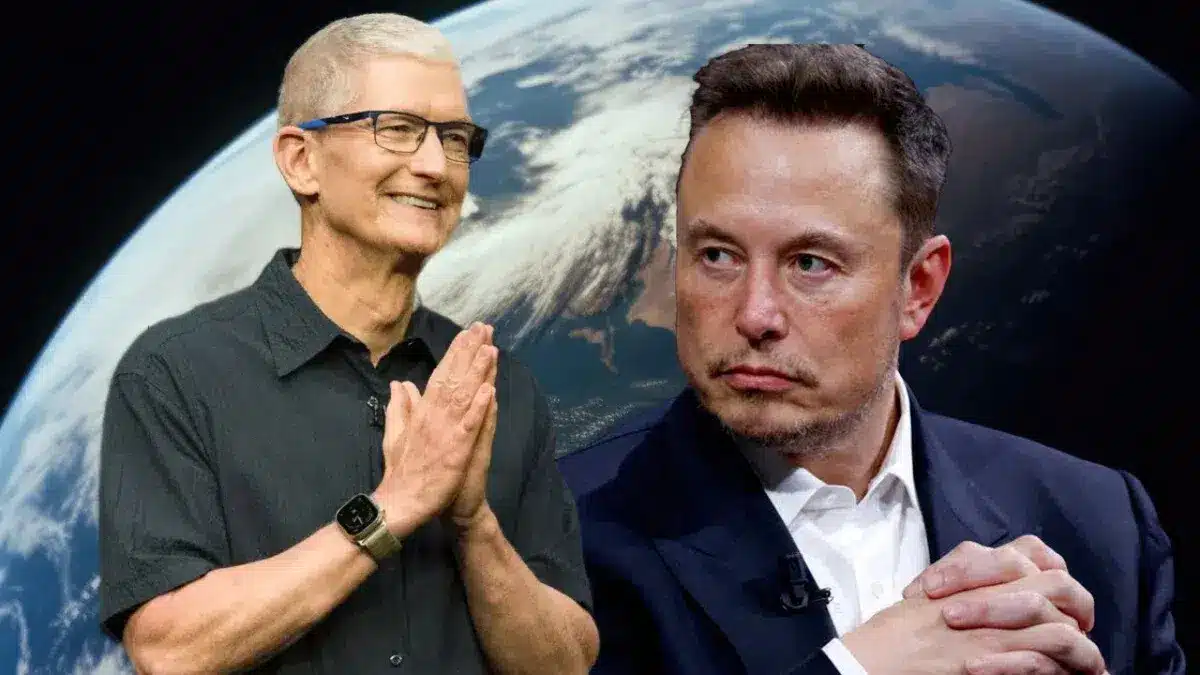
The ultimatum landed with clockwork precision, and the response was as brief as it was decisive. Tim Cook declined, and Elon Musk did exactly what he said he would do. Three years later, the consequences are visible, not just in corporate filings but in the night sky itself. The market for satellite-to-device connectivity has become a battlefield, and both Apple and SpaceX chose their weapons.
A call, a clock, a counterfactual
In August 2022, as Apple prepared the iPhone 14, Tim Cook took an unexpected call. On the line was Elon Musk, blunt and insistent, with a price and a countdown. The ask was $5 billion, the timeline was 72 hours, and the alternative was a direct confrontation.
“You have 72 hours. Either you pay $5 billion to integrate Starlink, or I become your direct competitor.”
Cook said no, and the timer ran out. Musk followed through, turning a perceived snub into a new market push.
The project Apple shelved
What Musk may not have known is that Apple had already stared at the same horizon. Back in 2015, Cupertino explored Project Eagle, a stealth effort to build a private satellite network with Boeing. The ambition was simple and sweeping: broadband from space for devices and homes, independent of carriers.
The risks were enormous, and the politics were delicate. Becoming a de facto operator could draw regulatory scrutiny, while angering carrier partners like AT&T and Verizon. Apple shelved the constellation, choosing control over speed and partnerships over provocation.
In the interim, Apple opted for something quieter. Emergency SOS via satellite launched with Globalstar, a constrained but useful lifeline for moments when towers go dark. No ego, no drama, and a service Apple could shape without turmoil.
Musk pivots with Direct to Cell
Two weeks before the iPhone 14 launch, Musk revealed his counter. SpaceX and T-Mobile would activate Starlink Direct to Cell, a service designed to let normal smartphones talk to satellites without special hardware. It targeted dead zones with something more than an emergency breadcrumb.
While Apple’s SOS lets you contact rescue teams from the wilderness, Direct to Cell aims at everyday connectivity: calls, texts, and data where networks never reach. Ironically, iPhones themselves can now touch those satellites, provided they ride on T-Mobile’s network.
Here’s how the approaches currently differ:
- Apple’s SOS focuses on emergency messaging, with guided prompts and limited bandwidth for safety scenarios.
- Starlink Direct to Cell seeks routine usage, enabling calls, texts, and basic data in remote or sparse coverage areas.
- Apple controls its experience, leaning on Globalstar to minimize operational complexity and reputational risk.
- Starlink controls the infrastructure, betting on scale and partnerships with carriers hungry for reach and resilience.
Power, risk, and the price of saying no
Apple’s refusal avoided dependence on an unpredictable partner, and protected a web of billion-dollar carrier relationships. It preserved a curated user experience, limiting outages, rule changes, and platform whiplash. It also meant ceding the first-mover advantage in mainstream satellite connectivity, at least in consumer perception.
For Musk, the rejection was an invitation to go bigger. Starlink continued to expand, from rural broadband to direct device links, testing in Chile and Peru before broadening availability. The message was unmistakable: if you won’t buy in, I’ll build the highway myself.
“The sky belongs to those who know how to reach it.”
That line could hang in Apple’s design studio, or in SpaceX’s Hawthorne factory. Both companies understand that control is the ultimate currency—over hardware, software, spectrum, and public narratives.
The stakes today
There is little doubt that satellite capability will spread across Apple’s portfolio. Reports suggest the Apple Watch Ultra 3 will add a space-based link, a natural extension of the SOS story. Apple will probably proceed the way it always does—slowly, privately, and with eventual boldness.
Starlink, meanwhile, is accelerating through partnerships and direct deployment. It is turning the world into a grid of coverage stitched by orbits, blending terrestrial towers with passing constellations. The result is a hybrid paradigm that redefines the edge of the network.
What the decision really means
In hindsight, Apple traded speed for stability, and drama for durability. It kept carriers close and its options open, even if that meant foregoing a headline-grabbing integration. Musk took the opposite bet, embracing pace, publicity, and the leverage of a private constellation.
Neither strategy is inherently right or wrong. One is a hedge against volatility and regulatory drag. The other is a wager that scale and momentum rewrite the rule book. What’s clear is that the competitive line has moved from the storefront to the sky, and the next chapter will be written in orbit—where coverage maps blur, and the network never truly goes offline.