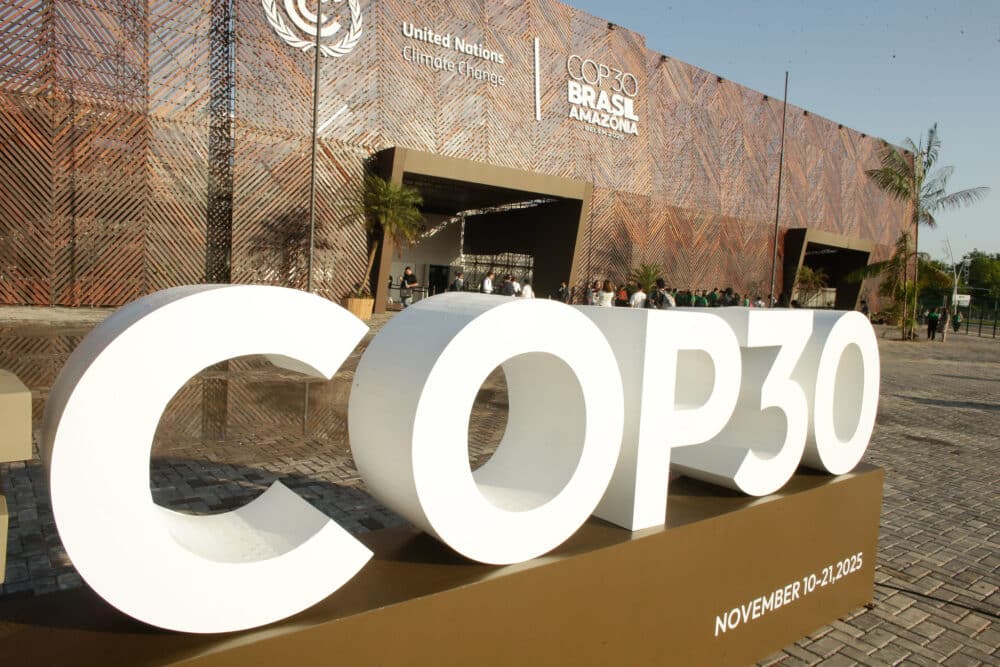
The absence of progress in phasing out fossil fuels, the increase in funding for adaptation and the creation of a mechanism for a just transition marked COP30, which ended Saturday in Belém.
At the 30th United Nations Climate Change Conference, which began on the 10th and ended today, one day after the deadline, nearly 200 countries finally reached an agreement, titled Mutirão Global, in reference to an Indigenous word that represents a community that works together toward a common goal.
The agreement, which had been feared impossible to reach due to the divergences between the various blocs of countries, was applauded by Brazilian President Lula da Silva as a victory for multilateralism, but the Executive Secretary of the UN Climate Change Convention, Simon Stiell, said he understood the frustration of some countries.
At the heart of the frustration is the fact that Lula da Silva’s proposal to approve a roadmap for phasing out fossil fuels, which had the support of more than 80 countries, was erased from the final agreement due to pressure from Arab countries, Russia, India and China.
“I know that some of you had bigger ambitions,” said the COP30 president, André Corrêa do Lago, at the final plenary, announcing then that the Brazilian presidency will keep the discussions on the roadmap until the next COP, in a year’s time.
However, that plan will not carry the same weight as an official decision approved at a United Nations conference.
Following the approval, Colombia, which was one of the most vocal in defense of the roadmap and announced the holding of a conference in April on fossil fuels, reacted with irritation to the absence of references to these fuels in the agreement.
To Portuguese journalists, the Environment Minister, Maria da Graça Carvalho, criticized Colombia’s position, which she accused of “trying to draw attention” after having supported the agreement.
For the Portuguese minister, the approved agreement is “the possible agreement,” underscoring that the alternative, which would be no agreement, “would be terrible.”
The European Commissioner for Climate, Wopke Hoekstra, admitted also that the 27 would have preferred “more, and more ambition in everything,” but they had to back the agreement because, “at least, it points in the right direction.”
Other countries also offered contained praise for the agreement, saying it represented the best possible given the difficult circumstances, while others criticized its content and the process.
“I cannot call this COP a success,” lamented the French Minister for Ecological Transition, Monique Barbut, to journalists. “It is an agreement without ambition, but it is not a bad agreement in the sense that it contains nothing unacceptable.”
The text also calls for efforts to triple by 2035 the funding allocated to adaptation in developing countries, which stood at 40 billion dollars and could thus reach 120 billion, but vulnerable countries considered the target insufficient.
Developed countries, including the EU, rejected increasing the total of public climate financing, which should total 300 billion per year by 2035.
A decision that was widely praised, notably by environmental associations, was the creation of a Belém Action Mechanism (BAM) for a Just Transition, to support countries in protecting workers and communities during the transition to clean energies.
Brazil also launched an innovative fund that will invest resources in the market and use the returns to pay the contributors and countries that protect forests.
The fund has already received about 5.5 billion dollars in initial commitments (Brazil, Norway, Germany, Indonesia, France and Portugal) and the final target is to raise 125 billion.
Environmental organizations consulted by Lusa expressed disappointment with COP30’s outcome, saying it fell short of expectations, but acknowledged the progress in approving a mechanism for a just transition.
Internationally the opinion was similar, with WWF considering the result modest and the few advances obtained insufficient to address the climate crisis, while Greenpeace said it is not the progress “the world desperately needs.”
“COP30 takes a hopeful step toward justice, but it does not go far enough,” commented the Climate Action Network.
COP30 was also marked by representing a return of civil society to these global climate meetings, after the last editions took place in countries with limited civil liberties, as well as by the large participation of Indigenous peoples.
On Saturday, halfway through COP30, thousands of activists and Indigenous people marched in the city of Belém against climate change and to demand responses from the leaders gathered in the city.
An intrusion into COP30’s restricted area by dozens of protesters, a protest by activists who blocked the conference entrance and a fire that led to the evacuation of the Blue Zone and its closure for more than six hours were among the episodes that also marked the climate conference.
After a lengthy dispute between Ankara and Canberra over who would host COP31, it was decided that the next summit will be in Turkey, but Australia will oversee the official negotiations.
The pre-COP, a meeting for technical consultations that takes place about a month before the conference, will be held in a Pacific island state.